Adsense2

Showing posts with label science. Show all posts

Friday, May 11, 2012

A few more egg unit projects

Hi every one! I still wanted to show you just a few more egg unit things we did. These ones are more Language Arts related. 


Most of the kids had reading comprehension IEP goals, so I was always trying to find new ways of practicing reading comprehension during Language Arts. By the end, I was starting to repeat some of the activities! I did come up with a new one... a giant crossword puzzle! I first did it after reading The Egg, by MP Robertson, because I found a printable crossword puzzle online, so I just reproduced it on a poster board. 


The kids liked it so much and asked to do it again, so I made my own crossword puzzle for A Chick Called Saturday, by Joyce Dunbar. For the second one, I used an online crossword puzzle creator, and then again reproduced it onto poster board. The kids worked on this as a group. Every student had a turn to hear a clue and write in the answer, but he could ask the others for help. Check this out!

I even added some of my own artwork at the bottom:

Another thing we did was read Chickens Aren't The Only Ones, by Ruth Heller, and then brainstormed a list of oviparous and nonoviparous animals. The kids usually like brainstorming activities, and it is good exercise for their brains. Each student had to come up with one oviparous and one nonoviparous animals, and at the end it was kind of a free for all where they could just toss in any ideas they thought of. Here is our brainstorming board:


And now, for the best part!
We were doing this whole egg unit because of the eggs we were trying to hatch in our incubator. Well,  during my final week at Tree Elementary, our eggs hatched! I actually got to see one hatch before my eyes. It really was like a miracle! I was even more excited than the kids!
Five chicks were born healthy. One was born sort of unhealthy. He was just laying on the ground and not moving. After some research I figured out that he was born with splayed legs, which could be easily fixed with a bandaid around his legs. I wasn't sure how to do it so we thought we should let the people at the farm take care of his legs. (Our chicks go to a no-kill farm near by, where they make more eggs for more schools to hatch.) The splayed leg chick wouldn't eat or drink, because he couldn't really move around. I ended up caring for him by mashing up bird seed in water, smearing it onto my hand, and then holding the chick in my other hand. If I held my seedy hand in front of him, he would peck it and eat the food. I gave him water by just sort of spooning it into his mouth. I got kind of attached to that little guy! I really hope they were able to fix him up once he got to the farm!

I totally want a pet chick now. 

Wednesday, May 9, 2012

Oviparous Animal Reports

Hi everyone! I'm back with even more activities we did for the egg unit!
A few weeks ago, I shared my oviparous animal report template, which was really just a simple concept map for kids to fill out. Last week, we used them. I wrote up one-page information sheets on ten different oviparous animals, including fun facts and photos on the pages. Each student had to pick their favorite oviparous animal, and use the information sheet to fill out the animal report template. We hung these on the wall in the hallway to share what we'd learned. The  kids really liked doing this, which was surprising to me because they complain about writing assignments a lot. Some of them (especially Kite) actually asked if they could do more!

Here is how our reports turned out. 


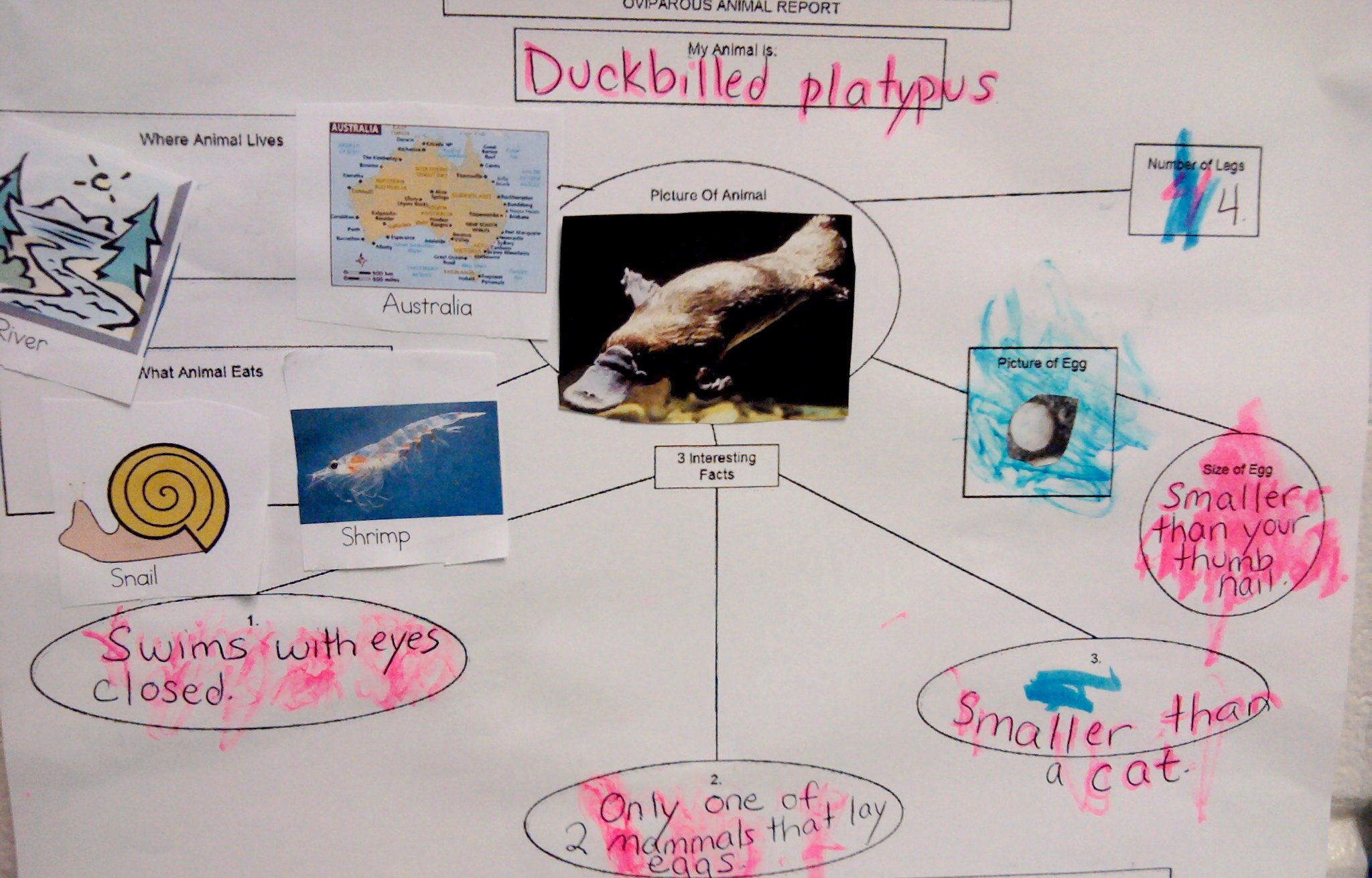
Here is Starling's. I actually helped her with a lot of it, because she came in late and missed a lot of the lesson, and because, well, she is Starling. I differentiated it for her and some other kids by including small pictures on the information sheet that they could glue onto the correct spots in the concept web, and I helped her find fun facts to include. 


Duckbilled Platypus
Lives: In Australia, near rivers
Eats: Snails and shrimp
Egg size: Smaller than your thumbnail
Number of legs: 4
Fun facts: Is one of only 2 mammals that lays eggs.
               Swims with its eyes closed.
               Is smaller than a house cat. 


Next is Kite's.


Sea Horse

Lives: On the bottom of the ocean
Eats: Loves to eat shrimp
Egg size: Very tiny
Number of legs: 0
Fun facts: They suck up shrimp through their snouts like a vacuum.
               Baby sea horses are on their own after they hatch. 
               They like to change colors to blend (into the) background. 


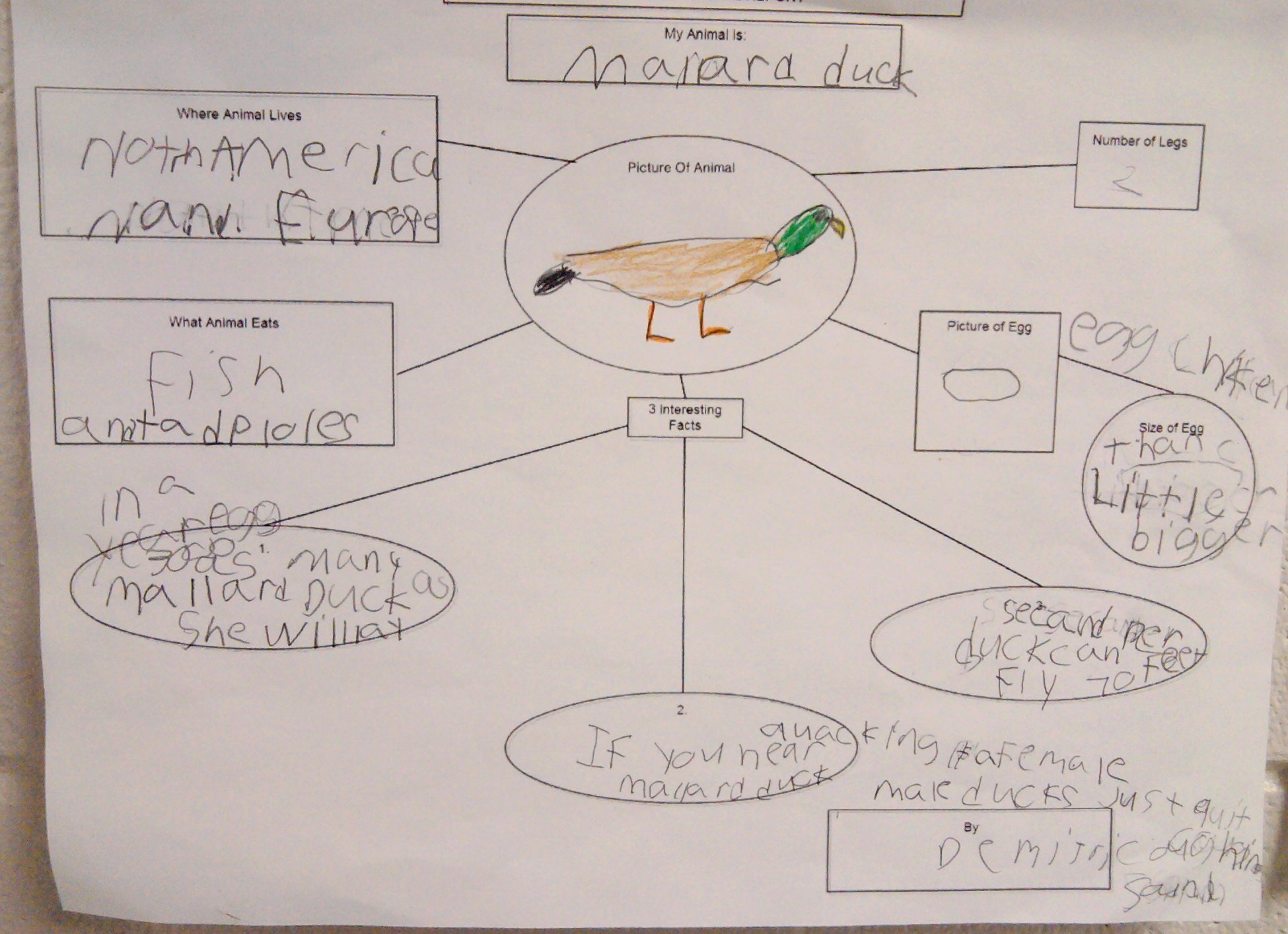
Oriole enjoyed doing his, although you can see the difficulties he has with writing. He puts all the words there, but not necessarily in any particular order.
Mallard Duck

Lives: North America and Europe
Eats: Fish and tadpoles
Egg size: A little bigger than a chicken egg
Number of legs: 2
Fun facts: A mallard duck will lay 300 eggs in a year. 
               If you hear a mallard duck quacking it is probably a female. Male ducks only make a raspy       coughing noise. 
               A mallard duck can fly up to 70 feet per second!


Here is Towhee's...
Adelie Penguin

Lives: Antartica
Eats: Fish 
Egg size: 2-4 inches tall
Number of legs: 2
Fun facts: Adelie penguins eat snow.
               Adelie penguins build their nests out of stones.
               Thee penguins are seen in the movie Madagascar. 


Next comes Martin's. He picked the wolf spider, but then he got sort of freaked out because he's a little afraid of spiders, and he didn't even like looking at the picture of one! He conquered his fear enough to finish this, luckily. 
Wolf Spider

Lives: Forests, meadows and gardens
Eats: Mosquitoes
Egg size: Tiny
Number of legs:8
Fun facts: The mom carries her babies.
                Lives on the ground.
                They have 8 eyes. 


Those are all the reports I have, since Rosella, Jay and Triller were out of the room and didn't get to do it. I was really proud of their projects! It seemed like they put more effort into these, and were able to learn more and use more of their drawing talents and thinking skills, than in other writing projects. I'm going to have to remember this for the future!


There are still a few more things I have to show you, so stay tuned!


Monday, May 7, 2012

Egg Lessons

Hi everyone! The good news is, I finally graduated on Friday! I am officially done with school, and will receive my certification over the summer! The bad news is, of course, that I really miss my class at Tree Elementary!


Even though I'm done student teaching, I have to catch up on posting the things I did in the last few weeks. So today, I thought I'd share some of the things I did during our Egg Unit! 


The unit was actually kind of scrawny, because by the time it started, we had so many other things going on. One week was only a three day week because of conferences, and the next week we had two field trips! However, here is what we did manage to do. 


On the first day we did something the kids really enjoyed, although I don't have pictures of it. I dissected a raw egg! I didn't let them do it themselves because this particular group has a lot of kids who stick everything in their mouths, and I didn't want them getting salmonella. But they did watch very closely, and they liked it a lot! 


First, showed them an egg, and we talked about the differences between the eggs in our incubator, and the eggs in the grocery store. A lot of the kids thought that the eggs in our incubator came straight from the grocery store, and that if they ate eggs they were eating baby chicks. I explained that the grocery store eggs are just "practice eggs" that were never fertilized and do not have chicks in them. 


Next, I asked them what they thought would happen if I squeezed the egg as hard as I could. They thought it would break, of course! So I took the egg and squeezed it (over a bowl, just in case) with all my strength! It didn't break! You can try that at home if you don't believe me. The shape of the egg makes it really strong, so that they don't break under the pressure of the hen sitting on them. 


Next, I took out a safety pin and chipped off some of the egg shell, so that they could see the membrane inside. They were very interested, because they never knew that an egg had this part. I explained that this membrane protected the baby chick from germs. After that, I actually broke the egg open into the bowl, so that we could talk about the parts. I peeled the membrane away from the inside of the shell so they could see it even better. We talked about how the egg white is actually called the "albumen" and that it acts as a cushion for the yolk. The yolk provides nutrition and water to the chick. We talked about how the chick doesn't have a little fork in there to eat the egg with, but the nutrition is absorbed through his skin. I showed them the little spot where the chick would be, if the egg was fertilized.  


I had an extra egg with me (just in case I messed up the first one) and, at the kids' request, I broke that egg for them to examine as well. They really loved the lesson... I heard lots of "Wow!" and "Whoa!" and "Cool!" The best part was, my professor was there observing that lesson, so it looked really good that the kids were that into it! Afterwards we did a little art project where they colored, cut, and pasted the layers of the egg on top of each other, so they had their own little egg diagrams. 


Okay. So that was kind of the introduction to the lesson. Another thing we did was play the game, "Chicken, Chicken, Where's Your Egg?" This game is played exactly like the old "Doggie, Doggie, Where's Your Bone" game that many of us played in elementary school. One person goes out into the hallway, while the rest of the group gets into a circle and chooses one person to hide the egg. (We used a plastic Easter egg!) Then the person in the hallway comes in and stands in the middle of the circle. The traditional poem goes, "Doggie, doggie, where's your bone? Somebody stole it from your home! Guess who? Maybe you! Maybe the monkeys in the zoo!" For the purpose of our Egg game, I changed the words to "Chicken, chicken, where's your egg? Somebody stole it from your nest!" I just stuck with those two lines, so it would be easier for the kids, many of whom have speech delays and short term memory issues, to say. (I also made a poster with the words, along with little pictures, to help them remember the lines. The person in the middle, aka the chicken, has to guess who is holding the egg. Traditionally, the person gets three guesses before they have to give up and be "out" or start over. But for our group, they had unlimited guesses. Otherwise probably nobody would have ever guessed correctly. We played until every kid had a chance to be the chicken and the hider. For the final turn, Mrs. Eagle got to be the chicken! The students loved it! When it was their turn to be the chicken, they would flap their arms and make clucking noises! It was a nice exercise on working together and problem solving. 


For the sake of not making this blog entry five hundred pages long, I'll cut this short for now, and continue the egg unit description later. Thanks for reading! 

Friday, April 27, 2012

How My Plant Unit Went

Hi everyone! Its been a while since I posted! I've done two units that I haven't written about at all... Since I'm graduating a week from today (!!!) I've been spending all of my time trying to get everything tied up and ready. Anyways I'll share my plant unit today, and then later I'll write about my fun egg unit! And next week you should be getting the chance to hear about our CHICKS! If they hurry up and hatch before we have to send them back to the farm, that is.

Okay. Plant unit. Lets see here.

The first day, we just concentrated on learning about what is a plant and what is not a plant. This is actually something the kids struggle with. They think rocks are plants, and school buses are alive because they move, and plants are not alive because they're not moving. We talked about what constitutes a plant, and the kids then got into partners and sorted pictures of plants vs. nonplants. 

We also read the book From Seed To Plant, by Gail Gibbons. (Who, by the way, has written a nonfiction book on just about every topic, and her books are amazing! Even teachers will learn a ton from these books, but they're written in a way that is friendly and easy for kids to understand.) We made a KWL chart, one of my favorite activities to do with kids when reading nonfiction books. Check out this KWL chart!
(Note that Jay insisted that I add that vampires hate sun, as a footnote to the part about sun helping plants make food. Vampires are one of his newest topics of interest!)

The next day, we learned about the things plants need to survive... air, water, soil, and sun. To drive this concept home, we planted our own plants... which, by the way, are still not growing. I'm actually going to try to grow some quickly at home using the plastic bag method, and then replant them in the kids' pots before they get to school one day. Shhhh... Don't tell them! Anyway, the kids had to put dirt into the pots, add seeds, water them, and figure out the best place in the room to put them. I didn't take pics because right now they're just pots of dirt.

We also read the book Growing Vegetable Soup, by Lois Ehlert. Then, as a group, we made up our own recipe for vegetable soup! The kids did pretty good at coming up with a realistic recipe. I had them think of all the steps. Here's what they came up with.

The third day, we learned about the parts of the plants. This was a little nerve wracking to me, because this was the day that I had to videotape a lesson for my professor to watch. I wish I could show you the video! It was pretty funny! Anyway we talked about the parts of plants and their jobs, and then they took turns shining a flashlight at specific parts of some large posters of plants. They were the most stumped by the fact that carrots actually are the roots of the plant, and that the stems of trees are actually their trunks. Finally, we made pictures of flowers on our lapbooks, added string for roots, and labeled the parts. I don't have a pic of that either. I actually have an example lapbook that I made, but my professor took it. I'll show you next week when I get it back!

We also write an acrostic poem, which I typed up and added to their lapbooks. Here's their poem:
Pine trees are a type of plant.
Leaves on trees are pretty.
Ants on some plants sting.
Needles on cactuses poke.
Taste a vegetable that grows on a plant.
Sunshine help plants grow.

The fourth day, we learned about the plant growth cycle. The kids went through learning centers. In one center, they made a growth cycle wheel for their lapbooks. In the next center, they did a puzzle that illustrated the growth cycle. In the third center, they put the growth cycle in the correct order in a file folder game. This was the kids' first time doing learning centers, so they were sort of baffled by the concept at first, but they really liked doing it!

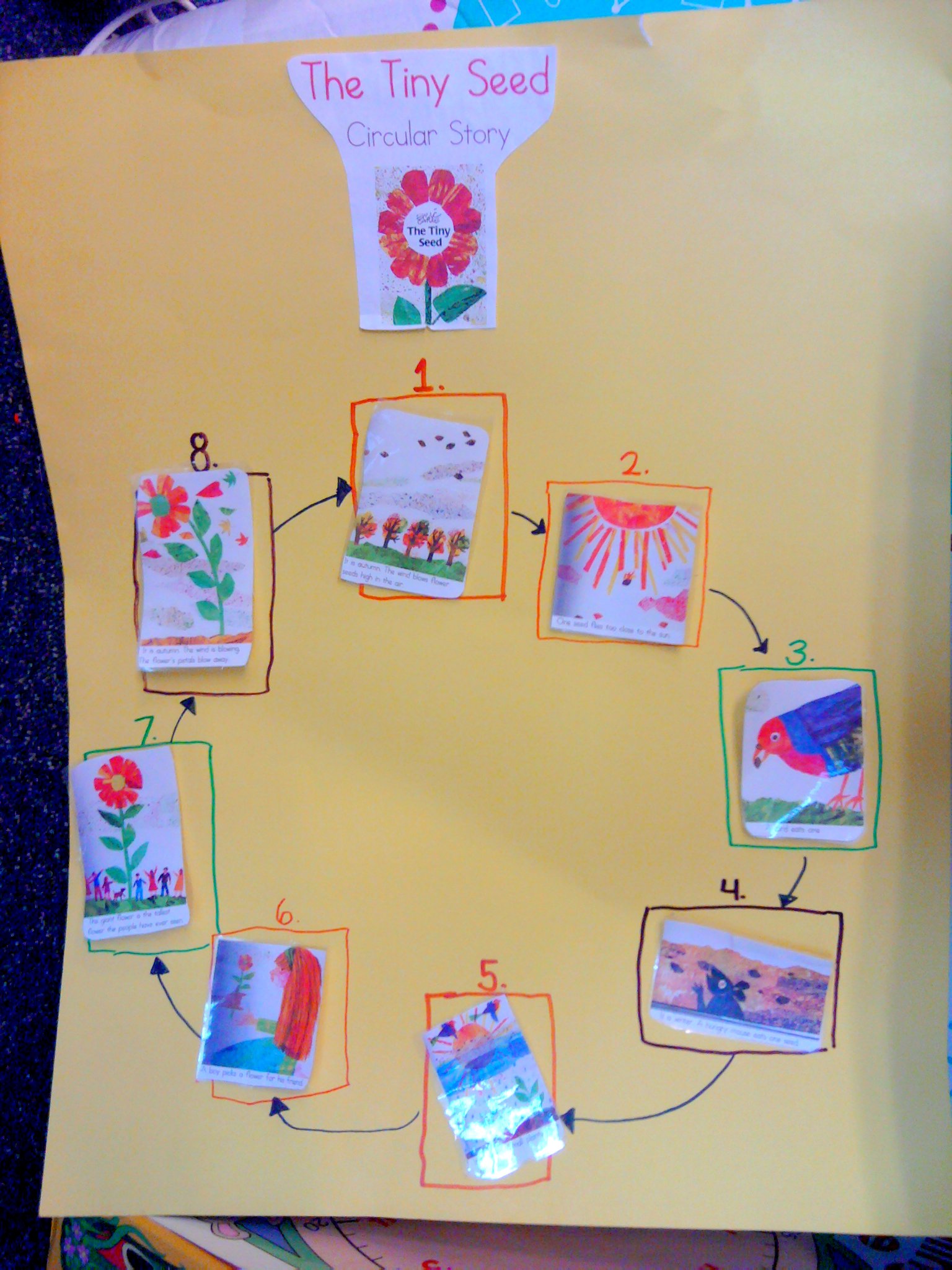
We also read the book, The Tiny Seed, by Eric Carle.  I told them that it was a circular story, and they had to figure out why. We did a sequencing activity, on a story board I made that looked like this:
When it was finished, they managed to figure out why the book was a circular story! The circular thing also went nicely with the growth cycle lesson we did that day.

The fifth day was our review day! We played an awesome team game. I made a giant game board that I posted up on the board. Each space had a piece of Velcro on it, and the pawns had Velcro on them too, so we wouldn't have to try to deal with gathering around a table. I also brought my homemade giant dice for the students to role. The game board looked like this.

The students were in teams of three. If they landed on a pink space, I handed them a picture of an item and they had to decide if it was a plant or not a plant. If they landed on purple, they had to name something plants need. If they landed on green, they had to point to a specific part on a poster of a plant. Landing on blue meant telling me the next stage of the growth cycle, using a poster. Landing on red meant a Bonus question, worth two points instead of one, that had a multiple choice question that was a little trickier. A silver space meant they could choose any color. The kids really liked playing... they had big smiles on their faces! 

So that was my plant unit. They all did really well on the post test. Rosella actually raised her score from a 65 on the pretest to a 95 on the post test! I was so proud of her! 

In other news, I have exactly four more days of student teaching. Monday and Tuesday I will spend the mornings observing in some of the other special ed classes. On Wednesday I'm planning on bringing treats and small gifts to say goodbye. (I got them each a Skippyjon book, since they all still talk about Skippyjon all the time and always check out Skippyjon books from the school library!) On Thursday, I'm going with the fifth graders on a field trip to the zoo. Hopefully Starling won't flip out this time. And on Friday, I graduate. I cannot  believe it! Can you? Its gone so fast!

Thanks for reading, everyone!